
Understanding Your Relationships and Transforming Your Life (TA)
Relationships have a profound impact on our well-being, confidence, decisions, and professional success. Yet many people find themselves repeating the same conflicts, facing similar challenges, or attracting the same types of situations without fully understanding why.
Why do some relationships repeatedly create tension?
Why do we react in ways that do not serve us?
Why do we seem to recreate the same patterns over and over again?
Transactional Analysis (TA), developed by psychiatrist Eric Berne, provides a powerful framework for understanding human behavior and communication. It helps us become aware of the unconscious patterns that influence our relationships and shape many aspects of our lives.
The goal is not to change who you are, but to increase your freedom of choice and create healthier, more fulfilling relationships.
Ego States: Who Is Speaking Through Us?
According to Eric Berne, our personality operates through three Ego States that influence how we think, feel, and behave.
The Child
The Child represents our emotional world.
It is the part of us that feels, imagines, creates, desires, and reacts spontaneously.
Depending on the situation, it may be:
- Free Child: creative, spontaneous, enthusiastic;
- Adapted Child: compliant, submissive, or rebellious.
The Parent
The Parent represents the rules, beliefs, and messages absorbed throughout childhood.
It may appear as:
- Nurturing Parent: supportive, protective, encouraging;
- Critical Parent: judgmental, demanding, or controlling.
The Adult
The Adult is the rational and objective part of ourselves.
It gathers facts, analyzes situations, and makes decisions based on reality rather than emotions or automatic beliefs.
The stronger the Adult state becomes, the more effective and balanced our communication can be.
The goal is not to eliminate any Ego State but to create balance among all three.
Transactions: How We Communicate
A transaction is any exchange between two people.
Transactional Analysis shows that many conflicts arise not from what is being said, but from the Ego States involved in the interaction.
For example:
- a manager may communicate from a Critical Parent state;
- an employee may respond from an Adapted Child state;
- communication between two Adult states is generally more productive.
Understanding Ego States helps us improve communication and avoid unnecessary misunderstandings.
Life Scripts: The Stories That Guide Our Lives
One of the most powerful concepts in Transactional Analysis is the idea of a life script.
During childhood, we absorb messages, beliefs, and conclusions about ourselves, others, and the world.
Over time, these messages form an unconscious script that influences:
- our decisions;
- our relationships;
- our confidence;
- our attitude toward success;
- our response to challenges.
Some people develop a script based on confidence, autonomy, and achievement.
Others may unconsciously repeat patterns of limitation, self-sabotage, or dependency.
The good news is that life scripts are not permanent.
They can be identified, questioned, and rewritten.
Life Positions: How We View Ourselves and Others
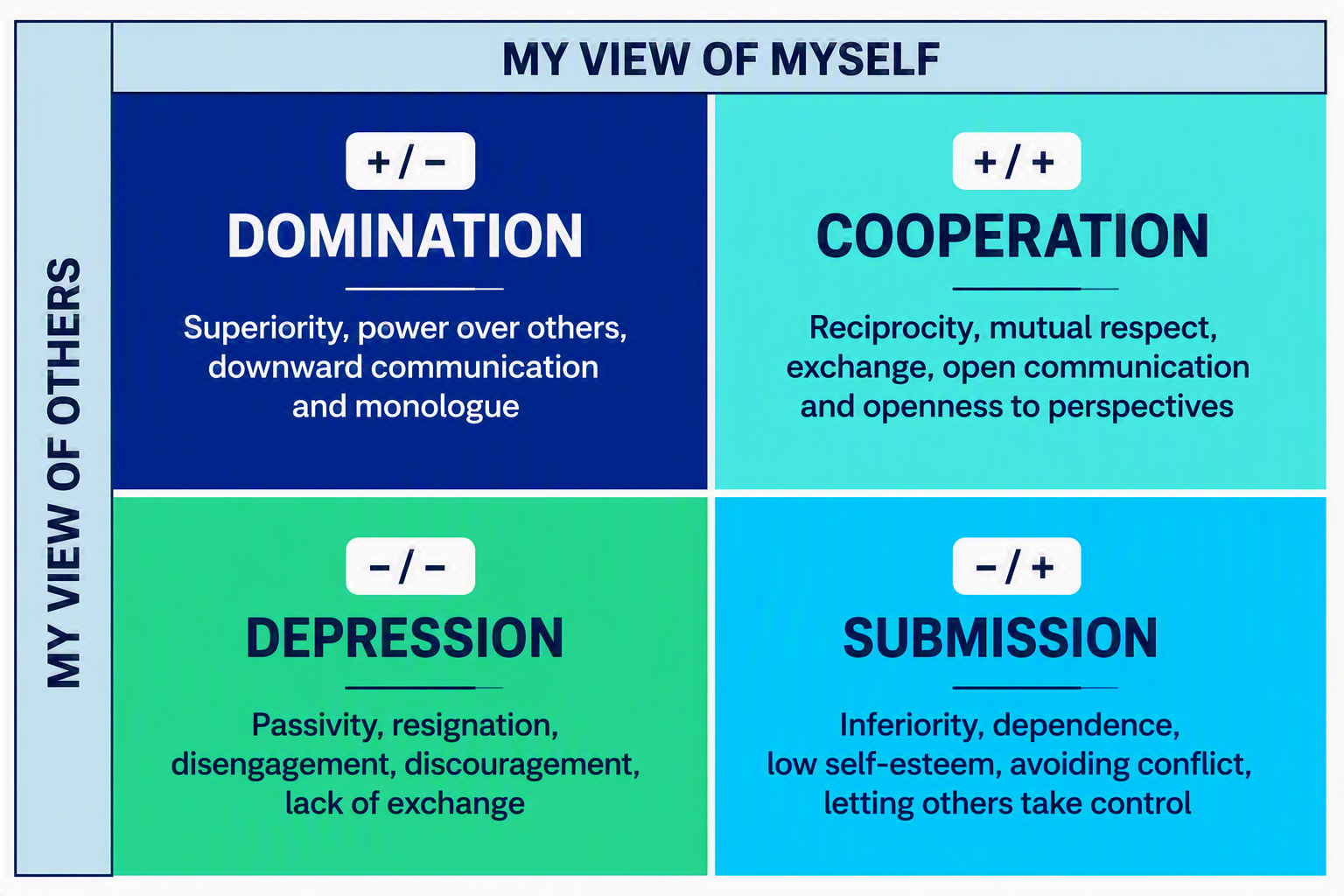
According to Eric Berne, people tend to operate from four life positions.
I’m OK, You’re OK (+/+)
This is the healthiest and most constructive position.
It is based on mutual respect, trust, and cooperation.
People recognize both their own value and the value of others.
I’m Not OK, You’re OK (-/+)
People see themselves as less capable or less valuable than others.
This position often leads to low self-esteem, dependency, or a victim mindset.
I’m OK, You’re Not OK (+/-)
People see themselves as superior and tend to judge or control others.
This position often creates power struggles and conflict.
I’m Not OK, You’re Not OK (-/-)
People develop a negative view of both themselves and others.
This position is often associated with discouragement, pessimism, and withdrawal.
Personal development and coaching frequently aim to help individuals move toward the healthiest position:
I’m OK, You’re OK.
Breaking Free from Psychological Games
Transactional Analysis also helps explain the psychological games that create recurring conflict and frustration.
These games occur when people react automatically instead of consciously choosing their responses.
The consequences often include:
- frustration;
- conflict;
- dependency;
- misunderstanding;
- emotional exhaustion.
Developing a stronger Adult Ego State allows individuals to step out of these patterns and regain personal responsibility.
How Coaching Can Help
Coaching often integrates principles from Transactional Analysis to help individuals better understand themselves and their relationships.
Coaching can help you:
- recognize recurring relationship patterns;
- better understand emotional reactions;
- strengthen self-confidence;
- improve assertiveness;
- break free from psychological games;
- develop authentic communication;
- challenge limiting beliefs;
- make decisions that align with your values.
The objective is not perfection.
The objective is greater awareness, freedom, and responsibility in your choices and relationships.
Taking Back Control of Your Relationships and Your Life
Understanding relationships begins with understanding yourself.
Transactional Analysis teaches us that we are not doomed to repeat the same patterns forever.
By becoming aware of our Ego States, life scripts, life positions, and psychological games, we can develop healthier behaviors and create more balanced relationships.
AFIACOACH supports individuals, managers, leaders, and professionals who want to improve communication, strengthen relationships, and create more fulfilling personal and professional interactions.
Do you find yourself repeating the same relationship patterns or facing the same challenges over and over again? Let’s explore your patterns together and create healthier, more conscious, and more rewarding relationships.
Recommended reading: What Do You Say After You Say Hello? by Eric Berne.
A classic reference for anyone who wants to better understand Transactional Analysis and the life scripts that influence human behavior.