
Understanding Dilts’ Pyramid: A Model for Personal and Professional Development
Most of us have experienced moments when, despite our efforts, progress seems slower than expected. We change our habits, learn new skills, or adjust our strategies, yet the results are not always sustainable.
Why do some changes last while others quickly fade away?
Dilts’ Pyramid, developed by Robert Dilts as part of Neuro-Linguistic Programming (NLP), offers a powerful framework for understanding personal and professional transformation. It helps identify the different levels that influence our behaviors, decisions, motivation, and long-term success.
Today, the model is widely used in coaching, leadership development, organizational transformation, and personal growth because it helps individuals focus on the root causes of change rather than simply treating symptoms.
Understanding the Logical Levels of Change
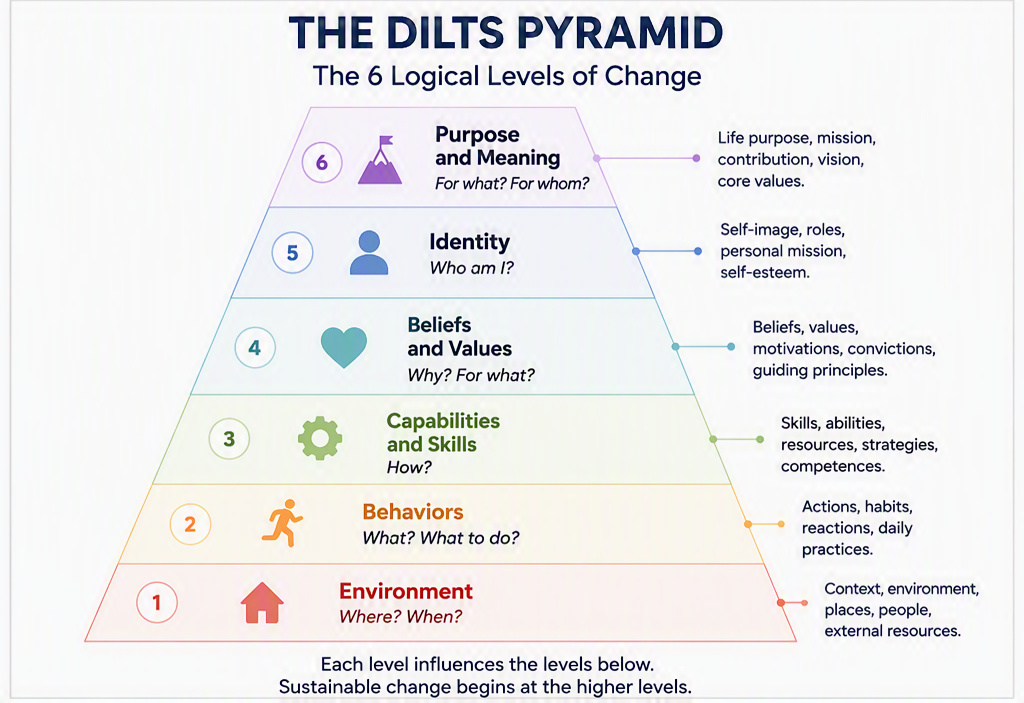
According to Robert Dilts, human development occurs across several interconnected logical levels.
The higher a level sits in the pyramid, the greater its influence on the levels below.
1. Environment
The environment refers to the external context in which we operate.
It answers questions such as:
- Where am I?
- When do I take action?
- Who am I surrounded by?
This includes:
- workplace conditions;
- personal environment;
- relationships;
- organizational culture;
- external circumstances.
Sometimes changing the environment alone can significantly impact results.
2. Behaviors
Behaviors represent what we actually do.
They answer the question:
What do I do?
This level includes:
- habits;
- actions;
- reactions;
- daily decisions.
Behaviors are observable and measurable.
3. Capabilities and Skills
Capabilities refer to how we perform our actions.
They answer the question:
How do I do it?
Examples include:
- technical skills;
- communication skills;
- leadership abilities;
- organization;
- emotional intelligence.
Developing capabilities often improves performance without changing goals.
4. Beliefs and Values
Beliefs and values strongly influence our behaviors.
They answer questions such as:
- Why is this important?
- What do I believe is possible?
- What motivates me?
Some beliefs empower us.
Others may limit us:
- “I am not good enough.”
- “I do not deserve success.”
- “Change is too risky.”
Working on beliefs is often one of the most powerful catalysts for transformation.
5. Identity
Identity answers the question:
Who am I?
It shapes how we see ourselves.
Examples include:
- I am a leader.
- I am an entrepreneur.
- I am a manager.
- I am an expert.
When identity changes, behavior often changes naturally and sustainably.
6. Purpose or Mission
At the top of the pyramid lies purpose.
It answers questions such as:
- Why am I here?
- What contribution do I want to make?
- What impact do I want to have?
This level is connected to:
- vision;
- meaning;
- contribution;
- legacy;
- fulfillment.
When purpose aligns with daily actions, motivation becomes stronger and more sustainable.
Why Is Dilts’ Pyramid So Powerful?
One of the most valuable lessons of the model is that problems rarely originate at the level where they appear.
For example:
- a performance issue may actually be caused by a lack of skills;
- a relationship issue may stem from limiting beliefs;
- a motivation issue may result from a lack of purpose.
The pyramid encourages us to address root causes rather than simply reacting to symptoms.
How Coaching Can Help
Coaches frequently use Dilts’ Pyramid to help clients identify the most relevant level for change.
Coaching can help you:
- clarify goals;
- identify obstacles;
- develop new skills;
- challenge limiting beliefs;
- strengthen self-confidence;
- evolve your professional identity;
- reconnect with your values;
- find greater purpose and alignment.
The objective is to create meaningful and sustainable transformation rather than temporary improvement.
Example: A Career Transition
Imagine Sophie, an experienced professional considering a major career change.
Using Dilts’ Pyramid, she explores her transition through several levels:
Environment: What type of work environment does she want in the future?
Behaviors: What actions does she need to take?
Capabilities: What new skills does she need to develop?
Beliefs and Values: What truly motivates her? What fears are holding her back?
Identity: Who does she want to become professionally?
Purpose: What impact does she want to make through her work and life?
By working through each level, Sophie creates a professional project that is aligned with her values, aspirations, and long-term vision.
Aligning Your Actions with What Matters Most
Dilts’ Pyramid reminds us that lasting change is not only about changing behaviors.
The most meaningful transformations occur when our actions, capabilities, beliefs, identity, and purpose are aligned.
AFIACOACH supports individuals, managers, executives, and entrepreneurs who want to unlock their potential, overcome obstacles, and create professional and personal projects aligned with their values and ambitions.
Do you have an important goal to achieve or are you navigating a period of change? Let’s identify together the most relevant level for transformation and build a path that is sustainable, meaningful, and motivating.