1. Why perform electrical safety tests?
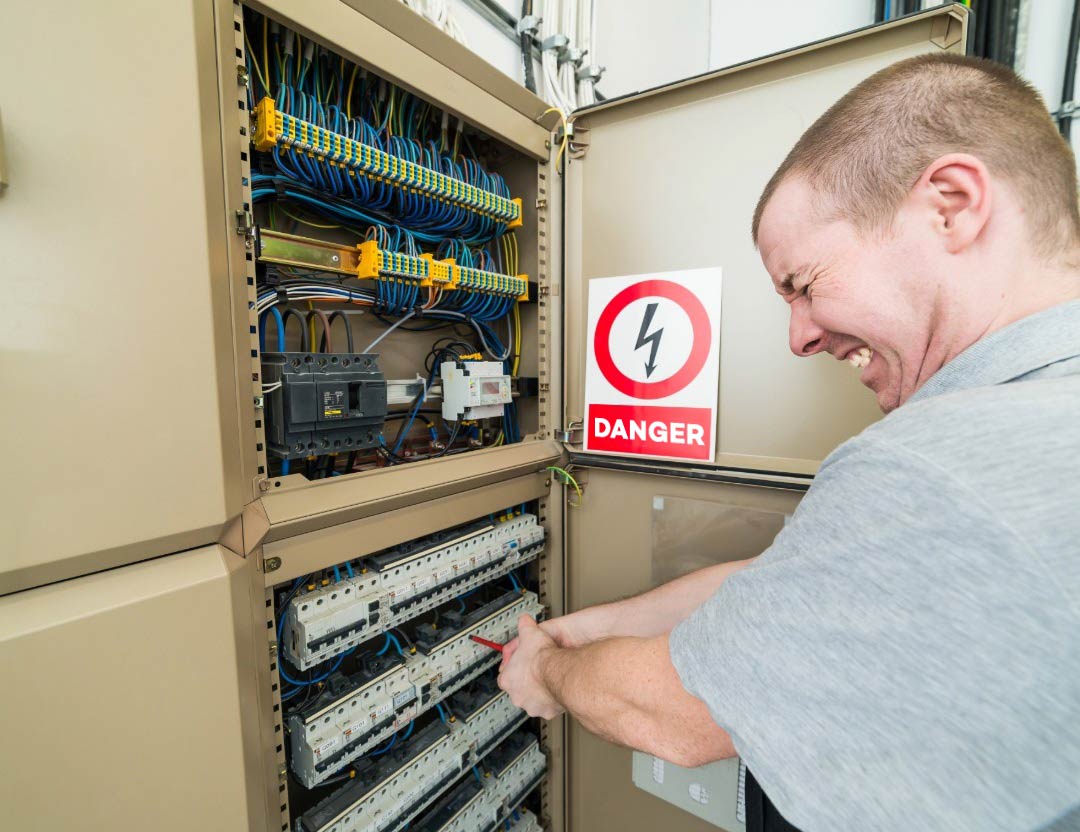
The main objective is to prevent accidents that could cause serious injury or fire. Over time, cable insulation can degrade, connections can loosen and internal components can fail.
A rigorous test makes it possible to:
- Prevent the risks of electric current on the human body
- Protect users and patients from electric shock
- Prevent fires caused by short circuits or overheating
- Comply with legal regulations (CE marking, European directives)
- Reduce the legal liability of manufacturers and healthcare organisations
2. The regulatory framework for electrical safety testing
In France, electrical safety tests are mandatory because they form part of the maintenance and quality-control operations required by the Public Health Code and the applicable standards.
There is no single text that explicitly requires electrical safety tests on medical devices. The obligation comes from a set of standards, decrees, orders and regulatory duties linked to maintenance and quality control.
In France, electrical safety tests mainly come from:
- Mandatory maintenance and quality control (Public Health Code, Art. R5211-5)
- International standards (IEC 62353, IEC 60601-1)
- CE marking requirements and the need to maintain performance
- The operator’s duties for the medical device
For more information, consult the documents on “Maintenance and quality control of medical devices” on the ANSM website (French National Agency for the Safety of Medicines and Health Products).
3. Operator obligations — Decree no. 2001-1154 (5 December 2001)
The decree frames the maintenance and quality control of certain medical devices in order to ensure their safety and performance.
Precise definitions:
- Operator: the person responsible for the activity that uses the medical device.
- Maintenance: actions intended to maintain or restore the correct operation of the device.
- Quality control: verification that performance is maintained, carried out internally or by an independent external body.
The operator must:
- put in place a maintenance policy
- perform the required quality controls
- keep an inventory, a written organisation and a register of all operations
- restrict use or restore conformity if a device fails
- report any serious risk to ANSM (materiovigilance)
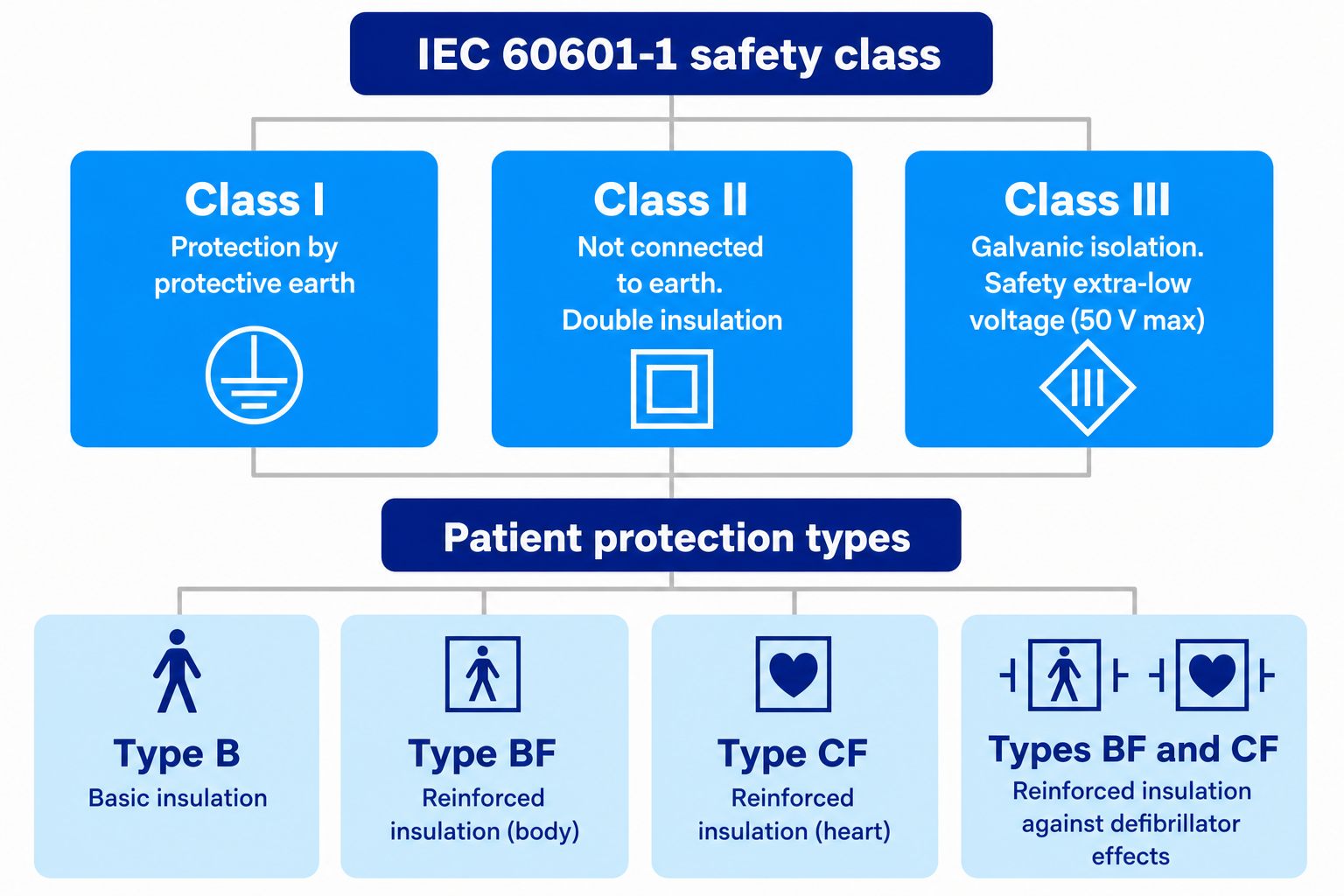
4. Classification of medical devices
According to European Regulation MDR 2017/745
European regulation classifies medical devices into four classes, based on their level of risk to the patient. The higher the risk, the stronger the requirements for safety, clinical evaluation and surveillance.

Class I electrical equipment — low risk to the patient
- Regulatory: manufacturer self-certification (except Is, Im, Ir) — basic safety and performance requirements, simplified conformity process
Class I equipment relies on protection by protective earth.
- If insulation fails, current leaks to earth → the circuit breaker trips, preventing electric shock
- Presence of a protective earth terminal (PE)
- The metal enclosure is connected to earth

Class IIa electrical equipment — moderate risk; Class IIb — high risk
- Regulatory: regular audits by a notified body, deeper clinical evaluation and quality-system verification
Class II equipment is designed to be safe without a protective earth.
- Double insulation or reinforced insulation between live and accessible parts. Even if an internal fault occurs, the double barrier limits the risk of shock.

Class III electrical equipment — very high risk
Regulatory: the highest level of control. Example: pacemakers — a very complex clinical file and a long, demanding certification process.
Class III equipment is designed around safety extra-low voltage (SELV, 50 V max) and galvanic isolation.
- The supply voltage remains low enough to limit the risk of electric shock
- Galvanic isolation separates the patient circuit from the mains
5. Patient protection types (IEC 60601-1)
IEC 60601-1 defines the B / BF / CF patient-protection types for applied parts and the level of protection against electric shock.
- Type BF and Type CF are F-type applied parts, i.e. isolated from earth — “floating”.
- Type CF imposes the strictest patient-current limits (up to 10 µA under normal conditions).
- Type B is generally earth-referenced, unlike F-types (BF/CF).
6. Summary of medical-device classification
The diagram below summarises IEC 60601-1 safety classes and patient-protection types.
7. Neutral system — earthing arrangements (SLT)
The neutral system defines how the transformer neutral and the metal masses of equipment are connected to earth. This choice affects:
- personal safety
- continuity of service
- the type of protection against insulation faults
According to NFC 15-100, a voltage above 50 V or a current above 30 mA can become dangerous, or even fatal.
The earthing arrangement specifies:
- whether the neutral is connected to earth
- how the metal masses of equipment are earthed or connected to the neutral
Its main purpose is to ensure automatic disconnection in the event of an insulation fault (phase-to-mass contact), in order to protect against indirect contact.
In France, three neutral systems are used:
- TT: mandatory in dwellings
- TN: common in industry
- IT: ensures continuity of service; mandatory in hospitals (operating theatre, delivery rooms, imaging, dental practices, etc.)
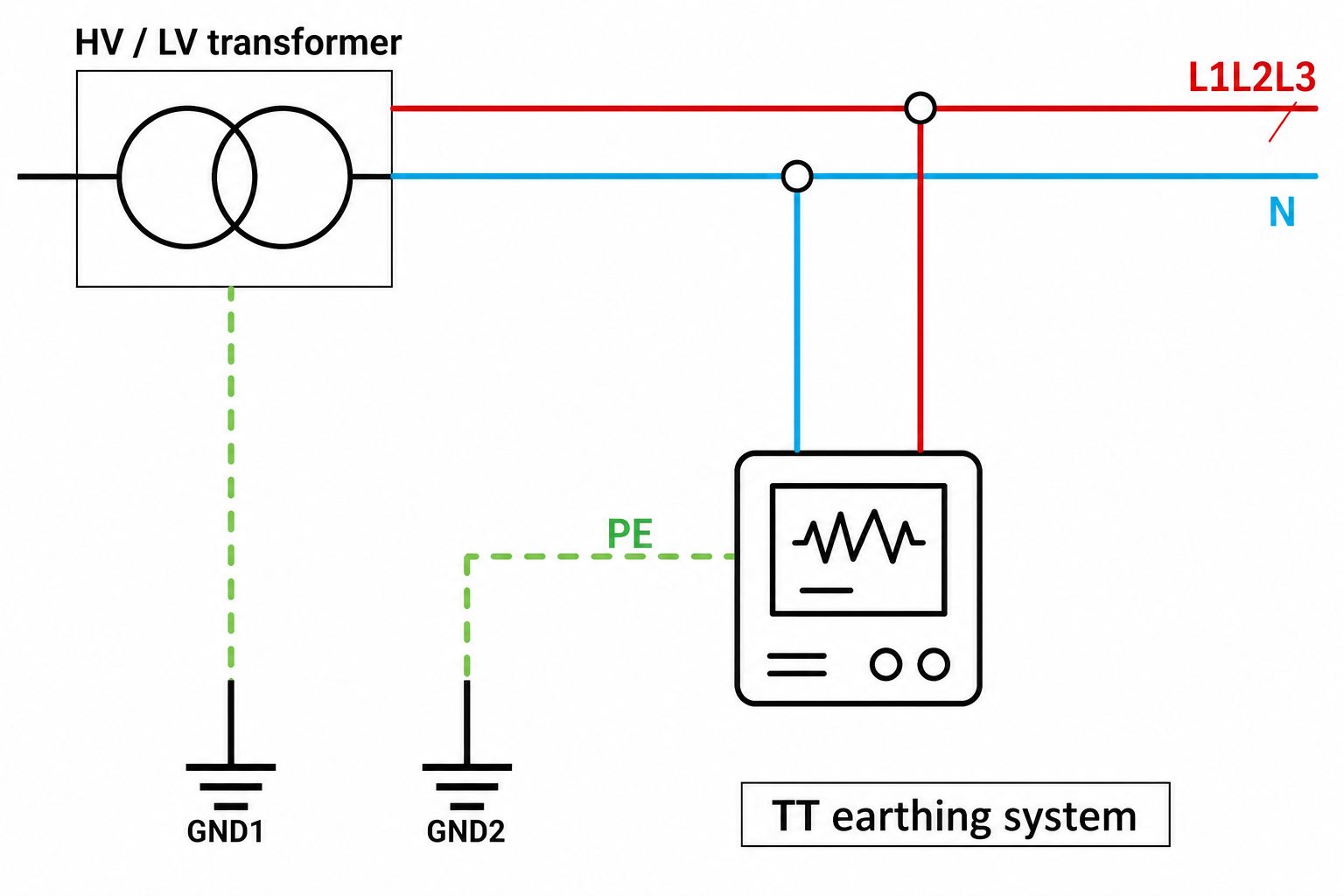
TT
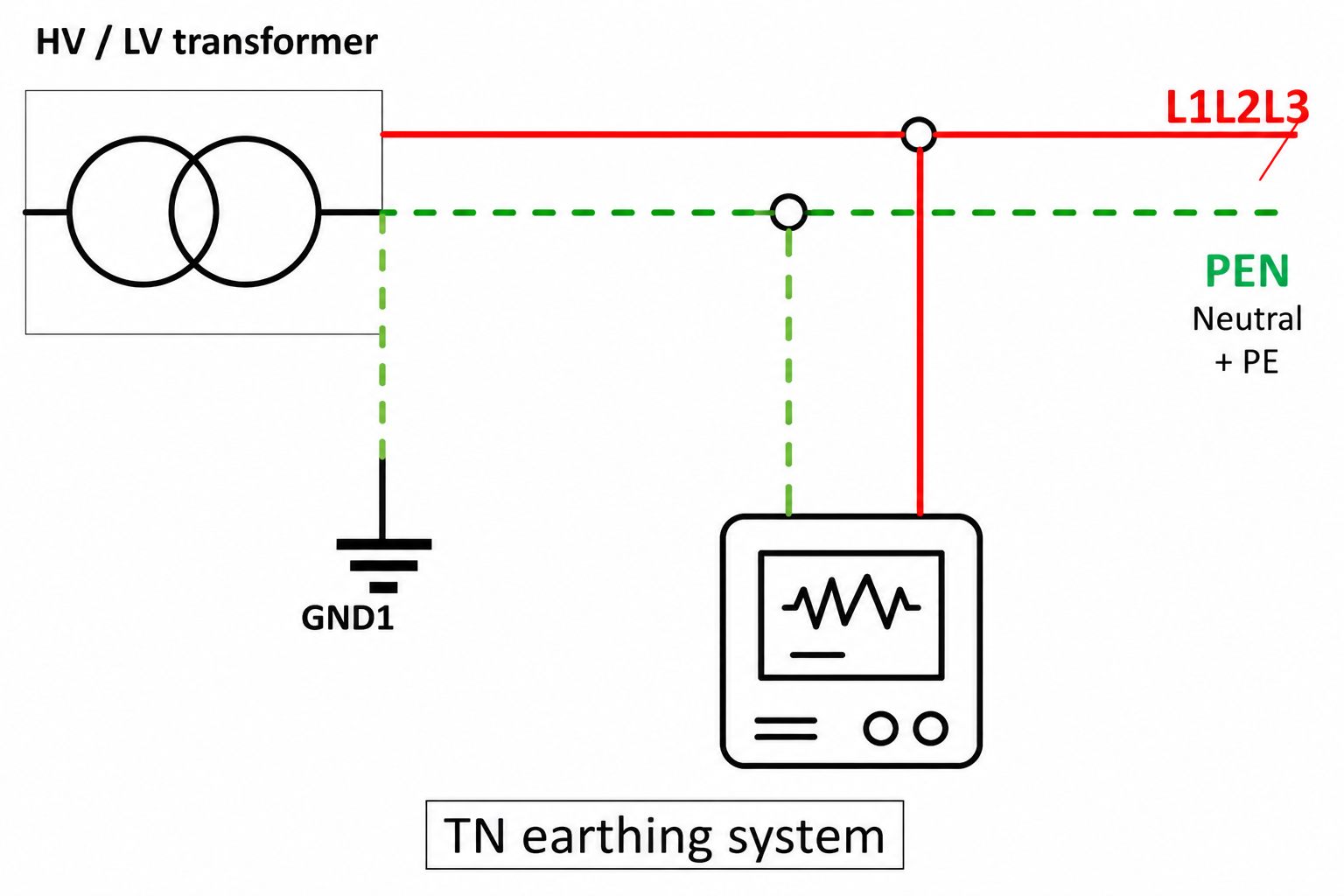
TN
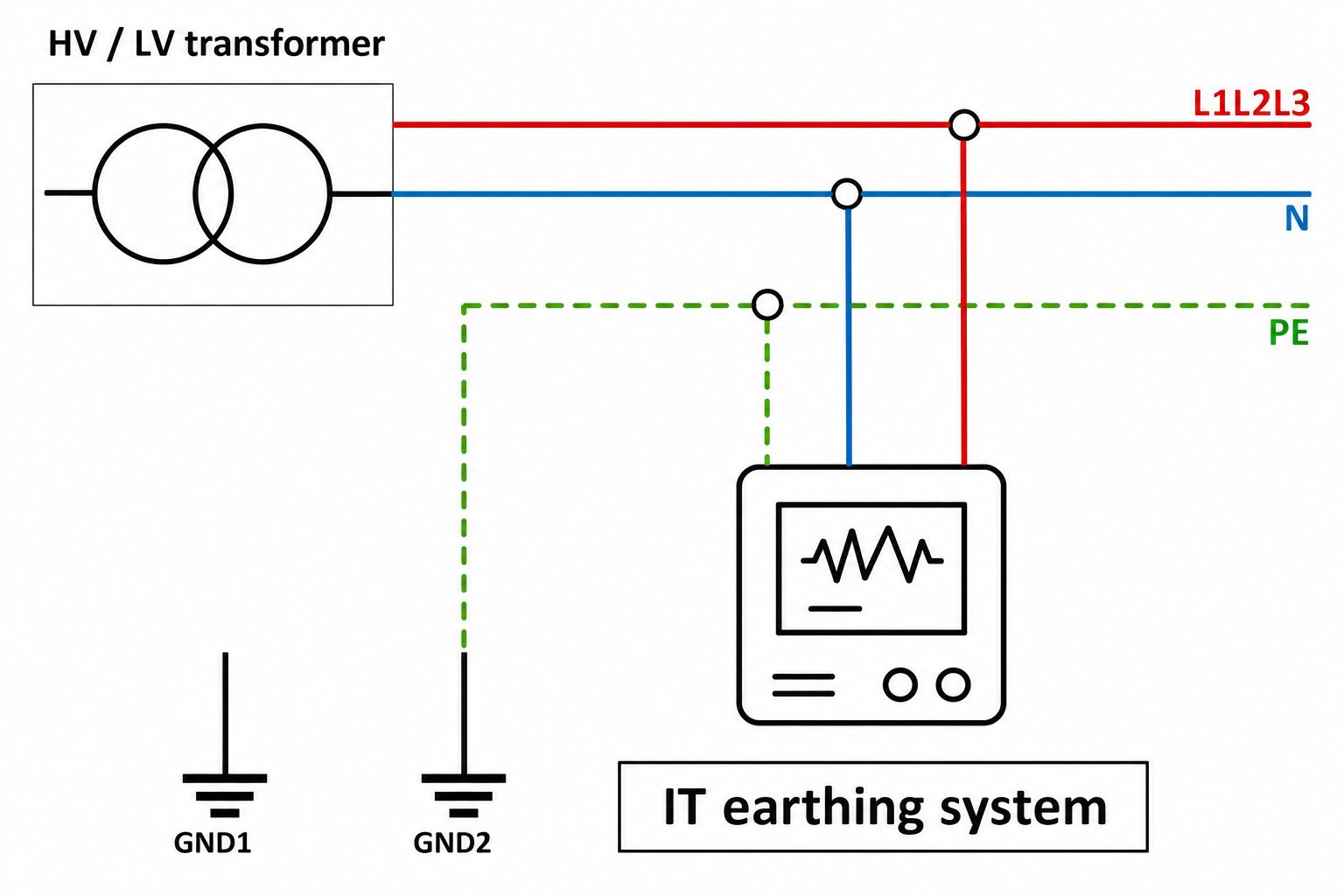
IT
Meaning of the letters:
- 1st letter: state of the neutral — isolated (I) or connected to earth (T)
- 2nd letter: how masses are earthed — earth (T) or neutral (N)
Note: In an IT system, a first insulation fault does not cause a disconnection. The fault current that flows to the metal enclosure remains very low because it returns through the neutral impedance. This low current avoids an immediate shutdown.
That is why hospitals must use this system in the operating theatre (NFC 15-211) and in any installation that needs high continuity of service. The IMD (insulation monitoring device) continuously watches the insulation. When a first fault appears, it detects it and signals it with a lamp or an alarm.
8. Electronic switch — on/off shutdown system
An electronic switch is a switch with no mechanical parts, based on components such as MOSFETs, triacs or solid-state relays (SSR). Unlike a classic switch that “clicks”, it controls the device supply electronically, often via a soft or touch button.
Electronic switches are very common in modern biomedical equipment, for example:
- infusion pumps
- multiparameter monitors
- ventilators
These devices often remain partly powered even when they are “OFF”, which indicates an electronic switch.
Why does this matter for electrical safety testing (IEC 62353)?
An electronic switch directly affects the appropriate test method. Some tests — especially direct leakage-current measurement — can be distorted because the internal electronics may:
- block the test current
- create alternative paths
- leave a residual current even in OFF mode
Result: incorrect measurements that do not represent real operation.
9. Electrical safety standards in healthcare
The main international electrical safety standards applicable to medical devices are:
9.1. IEC 60601 — safety of medical electrical equipment
This standard applies to manufacturers and laboratories to certify safety before placing a device on the market. It is not suited to routine in-service use. The (complete and demanding) tests include:
- Leakage currents: currents between applied parts, enclosure and earth
- Insulation resistance
- Dielectric strength: high voltage applied to check insulation withstand
- Protection against electric shock: creepage, clearance and barriers
- Normal condition and single fault
The objective is to guarantee basic safety and essential performance. The series includes:
- IEC 60601-1: general requirements for basic safety and essential performance
- IEC 60601-1-xx (collateral): EMC, usability, alarms, home use, etc.
- IEC 60601-2-xx (particular): specific equipment such as infusion pumps, or IEC 60601-2-4 for defibrillators
- IEC 61010: electrical safety of laboratory equipment
*In French: CEI (Commission Électrotechnique Internationale). In English: IEC (International Electrotechnical Commission).
There are three main editions of IEC 60601-1:
- 1st edition — 1977 / 1988. Historical baseline — simple electrical safety.
- 2nd edition — 1988 (A1/A2: 1995). More detailed requirements. Withdrawn in the EU in 2012.
- 3rd edition — 2005. Adds risk management, essential performance and a new structure; adopted worldwide.
The 3rd edition was adopted worldwide:
- EU: EN 60601-1:2006 (replaces the 2nd edition in 2012)
- USA: ANSI/AAMI ES60601-1:2006
- Canada: CSA 60601-1:2008
9.2. IEC 62353 — recurrent testing of equipment in service
The objective is to ensure ongoing international electrical safety and to detect degradation over time.
This standard is designed for corrective or preventive maintenance and regular checks of medical devices already in use. It offers simplified but reliable methods:
- Leakage-current measurement:
- direct method (device energised)
- alternative method (simulation without mains voltage)
- Protective-earth continuity
- Insulation test
- Functional check: alarms and essential performance
9.3. Related standards
A. ISO and quality standards
- ISO 14971: risk management for medical devices, including electrical risks
- ISO 13485: quality-management systems for medical-device manufacturers
B. Complementary and specific standards
- ISO 80601-2-xx: medical version of IEC 60601-2-xx (e.g. ISO 80601-2-13 for anaesthesia workstations)
- IEEE C95.1: safety related to electromagnetic-field exposure
9.4. Other international references
When a medical device is already in service, there is no single international standard that precisely defines the electrical safety tests to perform. Several countries have therefore developed national recommendations.
Depending on the region, tests may be required on delivery, at regular intervals, after maintenance or after repair. The most widely used references include:
- MDA DB9801 (United Kingdom)
- VDE 750/751 (Germany)
- AS/NZ 3551 (Australia and New Zealand)
- NFPA-99 and AAMI standards (United States)
10. Applying electrical safety tests in biomedical engineering
In France, two standards are mainly used to perform electrical safety tests on medical devices:
- Electrical safety testing — IEC 60601-1 / French version NF EN 60601-1
- Electrical safety testing — IEC 62353 / French version NF EN 62353
NF EN 62353 offers a simpler, faster and safer approach for testing medical devices in service, by greatly reducing the number of measurements and the duration of the tests.
Important: always refer to the medical-device manufacturer’s manual for recommended verification and electrical safety tests.
10.1 Comparison of electrical safety tests
| IEC 60601-1 | IEC 62353 |
|---|---|
| Protective earth resistance | Protective earth resistance |
| Insulation resistance | Insulation resistance |
| Earth leakage current | (Part of equipment leakage) |
| Touch current (enclosure leakage) | Equipment leakage current |
| Patient leakage current | Applied part leakage current |
| Patient auxiliary current | (Not a routine test) |
| Mains on applied part (MAP) | Applied part leakage (mains voltage) |