
Electric currents that pass through the human body can produce a wide range of physiological effects. These effects depend mainly on current intensity, frequency, exposure duration, the current path through the body and individual sensitivity.
The danger of electricity does not depend only on voltage (Volt), but above all on the intensity of the current (Ampere) that flows through the body and on the duration of exposure.
Electrical thresholds and physiological effects
1. Perception threshold
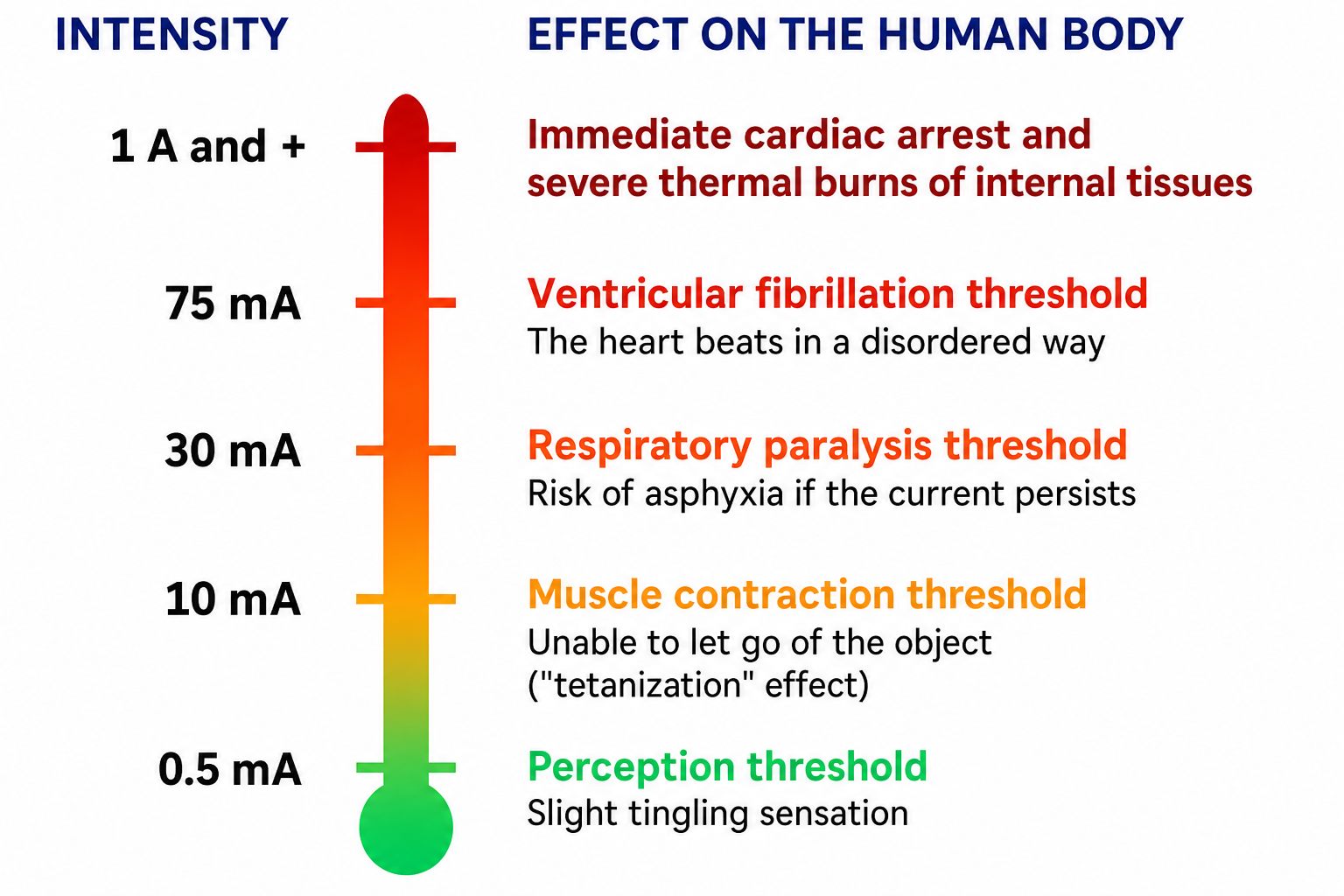
The perception threshold is the lowest current that a person can detect.
- Orders of magnitude:
- ≈ 1 mA at 50/60 Hz
- ≈ 5 mA at 10 kHz
- ≈ 10 mA at 100 kHz
- This threshold varies widely depending on:
- the individual,
- measurement conditions,
- the organs involved.
- Some organs are particularly sensitive:
- Retina: the lowest threshold in the body → ≈ 20 µA. As described by Brindley, this is a luminous visual sensation (spots, flashes, diffuse shapes) perceived without external light stimulation, caused by direct electrical stimulation.
- Tongue: → ≈ 45 µA according to Dalziel’s work.
2. Let-go threshold
The let-go threshold is the highest current at which a person can still voluntarily release a live object.
- Physiological mechanism:
- For an equivalent stimulus, the flexor muscles of the hand are stronger than the extensor muscles.
- This produces an involuntary contraction that prevents release.
- Effects beyond the threshold:
- intense stimulation of nerves and muscles,
- pain and muscle fatigue,
- progressive tetanization.
- Orders of magnitude:
- ≈ 10 mA at 50/60 Hz
- ≈ 50 mA at 10 kHz
3. Influence of frequency
Current frequency systematically influences physiological effects:
- At equal current:
- The higher the frequency, the weaker the physiological effect.
- Low frequencies (50/60 Hz) are therefore the most dangerous for the human body.
Physiological effects by intensity (for a 50 Hz alternating current):
4. Respiratory and cardiac arrest
Respiratory arrest
Respiratory arrest is caused by tetanization of the respiratory muscles:
- intercostal muscles and diaphragm locked,
- inability to breathe ⇒ asphyxia.
- Orders of magnitude:
- 20 to 30 mA at 50/60 Hz
- exposure of 2 to 3 minutes
Cardiac arrest
Circulatory arrest may appear as:
- a complete stop of the heart,
- or cardiac fibrillation.
- Orders of magnitude:
- 100 to 500 mA at 50/60 Hz
- strongly depends on the timing of the shock in the cardiac cycle.
Note: The danger of an electric shock depends on the current path through the body, contact conditions — skin condition (dry, damp or wet) — and current intensity (contact voltage, pressure applied, contact area), with a major risk when the heart is in the path.
Cardiac fibrillation and the timing of the electric shock
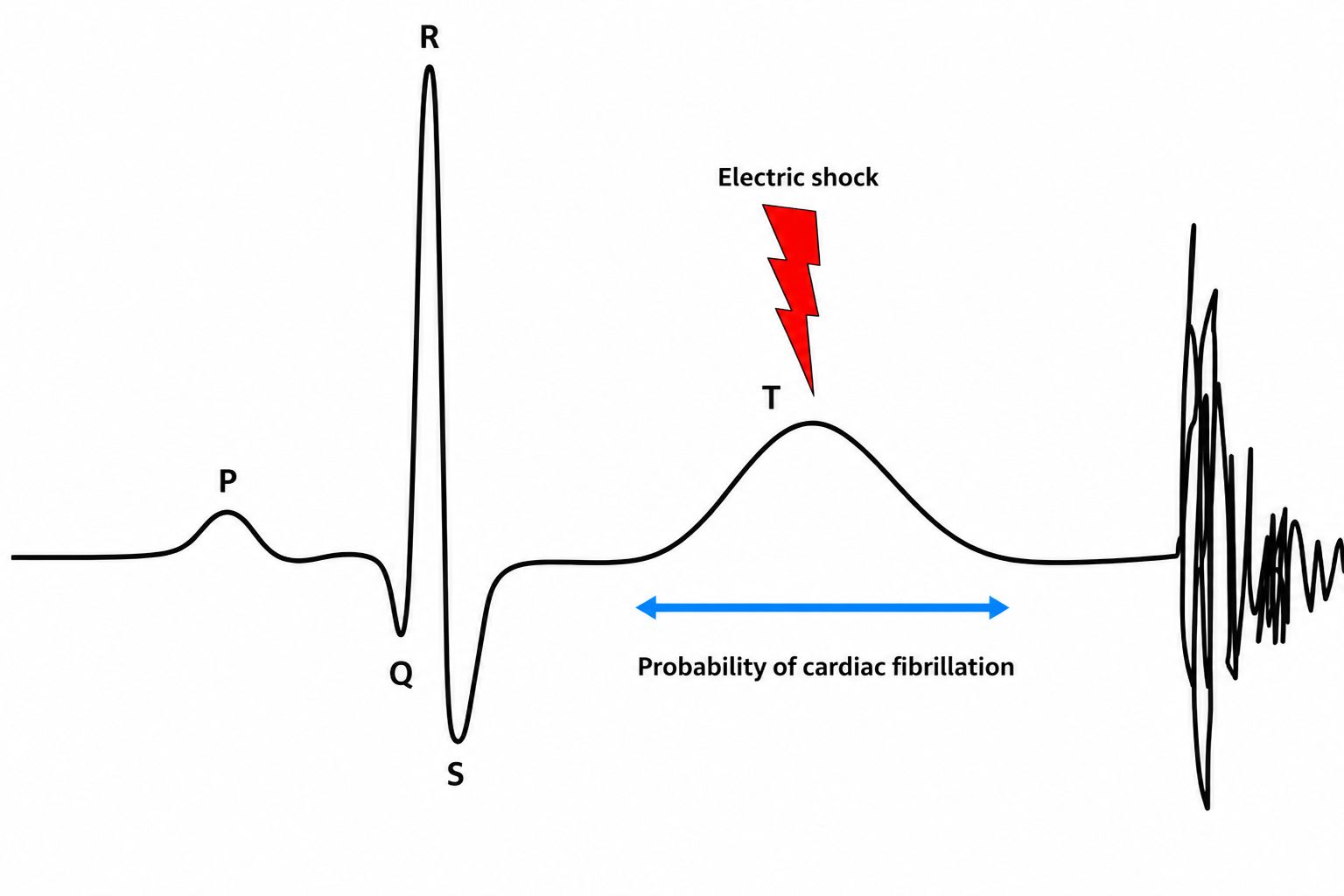
The risk of cardiac fibrillation depends on the moment the electric shock is applied:
- some moments of the cardiac cycle are particularly critical,
- a shock applied during these phases (T wave) greatly increases the probability of fibrillation,
- this explains the wide variability of effects for currents that are otherwise similar.
Key takeaways
The physiological effects of electric currents depend not only on intensity, but also on frequency, duration, current path and the moment of application, which makes their impact complex and potentially very dangerous.